
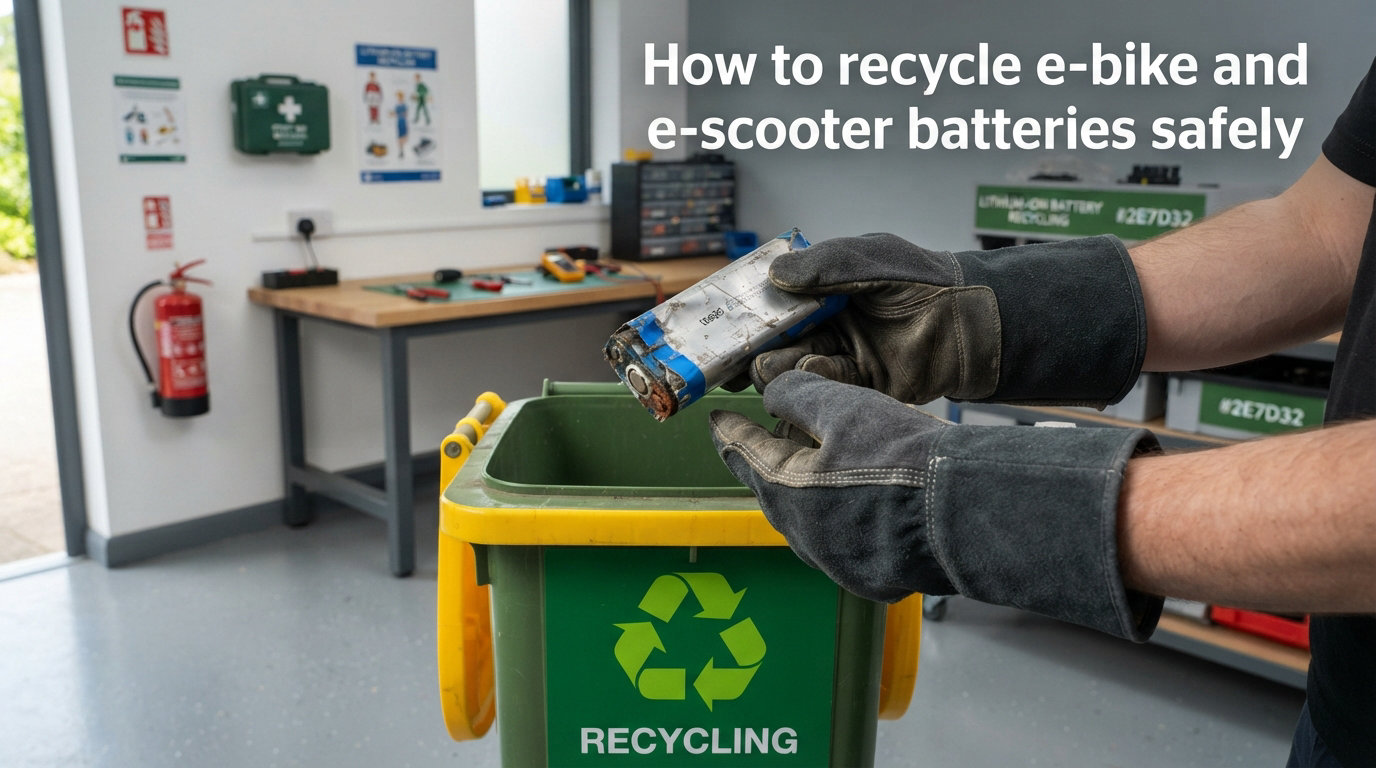
Over 5,000 fires erupt at waste and recycling facilities every year because lithium-ion batteries end up in the wrong place. Many of those fires trace back to e-bike and e-scooter batteries tossed in household trash or curb-side bins. Our team has spent the past three months talking to recycling facility managers, fire inspectors, and battery engineers to understand what really happens after a battery leaves your garage.
I want to walk you through how to recycle e-bike and e-scooter batteries safely in 2026, from spotting end-of-life signs to choosing the right drop-off location and handling damaged cells without starting a fire. We will cover both e-bikes and e-scooters, since most guides focus only on one type and leave scooter riders guessing.
By the end, you will know exactly which batteries qualify for recycling, where to take them, what materials get recovered, and how to stay safe during transport. We will also cover legal requirements under U.S. universal waste rules, a few practical tips that can extend your battery’s life so you delay recycling in the first place, and what to do when a battery is already damaged. Let’s start with the reasons this matters before you ever lift a battery out of its mount.
Table of Contents
Why Proper Disposal of E-Bike and E-Scooter Batteries Matters?
Lithium-ion batteries power nearly every modern electric bike and scooter, and they pack an enormous amount of stored energy into a small package. A typical 500Wh e-bike battery holds enough energy to power a laptop for three weeks or to push a 180-pound rider up a steep hill for an hour. That energy is exactly what makes them so useful, and exactly what makes them dangerous when they end up in the wrong stream of waste.
The Fire Risk at Waste and Recycling Facilities
The Consumer Product Safety Commission has linked more than 5,000 fires annually at recycling and waste facilities to discarded lithium-ion batteries. Those fires happen when batteries are crushed, punctured, or exposed to heat during compaction in garbage trucks. Once one cell ignites, the heat cascades through the rest in a chain reaction called thermal runaway.
Thermal runaway is a self-accelerating chemical reaction inside a battery cell. Once it starts, internal temperatures can exceed 1,000°F in seconds. The reaction releases flammable gases, sparks, and toxic smoke, and it cannot be stopped with water alone. Fire departments now classify these incidents as hazardous materials events, not ordinary structure fires, and they often require specialized foam and weeks of monitoring to fully extinguish.
The numbers are climbing every year. Lithium-ion battery fires at U.S. waste facilities jumped 78% between 2022 and 2025 according to a recent EPA analysis, and e-bike batteries account for a growing share of those incidents. Each fire can shut down a sorting facility for days, contaminate surrounding property, and put sanitation workers in serious danger.
The Environmental Cost of Improper Disposal
Beyond the fire risk, the materials inside lithium-ion batteries pose serious environmental threats. Cobalt, nickel, lithium, and manganese can leach into soil and groundwater when a battery ends up in a landfill. Even a single discarded e-bike battery can contaminate thousands of gallons of groundwater over time, and that contamination shows up in drinking wells and downstream ecosystems.
Studies from the United Nations Environment Programme estimate that every ton of lithium-ion batteries sent to landfill releases roughly 200 kilograms of heavy metals into the surrounding environment. Those metals do not break down. They accumulate in fish, in crops, and eventually in the people who eat them. Recycling keeps those materials out of the soil and puts them back into the supply chain.
That is why the U.S. Environmental Protection Agency classifies spent lithium-ion batteries as universal waste. They cannot legally go in regular trash in most states, and federal regulations under RCRA Subtitle C govern how they must be stored, transported, and processed.
Recognizing When Your E-Bike or E-Scooter Battery Has Reached End-of-Life
A battery is ready for recycling the moment it can no longer safely power your ride. Most quality lithium-ion packs last between 3 and 5 years, or roughly 500 to 1,000 charge cycles, before their capacity drops below 70% of the original rating. Once you hit that threshold, range drops sharply and replacement becomes the safer option.
The first warning sign is reduced range. If your e-bike used to cover 40 miles on a single charge and now struggles to hit 25, your battery cells are degrading. Capacity loss is normal chemistry, but a sudden drop in range often signals a failing cell that should not be ignored. I replaced my own battery last year after range dropped from 38 miles to 19 miles over a single riding season, and a cell test confirmed two weak cells inside the pack.
Swelling is the second sign, and the most urgent. A pouch or cylindrical cell that puffs up means gases are building up inside, usually from overcharging, heat damage, or internal short circuits. A swollen battery is a fire hazard. Do not charge it, do not ride on it, and start planning immediate recycling.
Overheating during charging is the third signal. A warm battery is normal. A battery hot enough to discolor its casing or melt nearby plastic is not. Unplug the charger immediately, move the battery to a non-combustible surface, and call your local fire department’s non-emergency line for advice if you notice smoke or smell a sweet chemical odor.
Other end-of-life indicators include unusually long charge times, the battery cutting out under load, visible corrosion on the connector pins, and error codes flashing on your display. Any one of these signs means the battery has crossed the line from “aging” into “ready for recycling.”
One thing to watch for in colder climates: capacity loss in winter does not always mean end-of-life. Lithium-ion cells temporarily lose 20% to 30% of their capacity below freezing. If range drops sharply in January but recovers in May, your battery is healthy and just reacting to temperature.
How to Recycle E-Bike and E-Scooter Batteries Safely: Step-by-Step
The actual process of recycling an e-bike or e-scooter battery is straightforward once you know the steps. I run through this routine with every battery I retire, and it usually takes less than an hour from start to finish. The hardest part is usually just finding a drop-off site and getting the battery there.
Step 1: Identify Your Battery Type
Check the label on the side of the battery pack or in your owner’s manual. You are looking for the chemistry (lithium-ion, LiFePO4, or NiMH) and the voltage (commonly 36V or 48V for e-bikes, 24V to 42V for e-scooters). Recyclers need this information to route the battery to the correct processing stream. Older e-bikes from the early 2010s sometimes use NiMH or sealed lead-acid packs, which require different recycling routes.
Step 2: Discharge the Battery Safely
Most certified recyclers ask that you discharge the battery to about 30% before transport. A full charge stores more energy and increases fire risk if the battery is damaged in transit. Run your bike or scooter for a short ride, then check the indicator lights. Do not fully drain the battery, since a deeply discharged lithium-ion cell can enter an unstable state and even short-circuit internally.
Step 3: Protect the Terminals
Cover both terminal contacts with electrical tape or non-conductive caps. This prevents accidental short circuits if the battery contacts a metal surface in your car or recycling bin. I keep a roll of electrical tape in my battery prep kit for exactly this purpose. Painter’s tape also works in a pinch.
Step 4: Place the Battery in a Non-Conductive Container
Put the taped battery in its original plastic case if you still have it. If not, use a sturdy cardboard box lined with a plastic bag and some sand or kitty litter for cushioning. Never transport lithium-ion batteries loose in a trunk with metal tools or other batteries. A single contact between positive and negative terminals can ignite a fire.
Step 5: Choose a Certified Recycler
Search the Call2Recycle locator at call2recycle.org to find your closest certified drop-off site. You can also bring the battery to a participating bike shop, e-scooter retailer, or municipal household hazardous waste facility. Avoid generic scrap metal yards that do not specialize in lithium-ion handling, since they often sort batteries like any other metal.
Step 6: Transport and Document
Drive the battery directly to the drop-off location. Keep it upright in your passenger area, not in a hot trunk. Ask for a receipt or certificate of recycling, since some manufacturers require proof of proper disposal before honoring any remaining warranty claims. I keep a small folder of recycling receipts for every battery I have ever turned in, which has helped twice during warranty claims.
Where to Recycle E-Bike and E-Scooter Batteries
The single fastest way to find a legitimate drop-off site is the Call2Recycle locator at call2recycle.org. Call2Recycle is a non-profit stewardship program that partners with over 13,000 collection sites across the United States and Canada. Type in your zip code, and the site will show bike shops, hardware stores, and municipal facilities that accept your battery type. The site also flags whether each location accepts high-voltage e-bike packs or only small household cells.
Most major bike shops that sell electric bikes will take back old batteries, even if you did not buy the bike from them. Trek, Specialized, REI, and many independent dealers participate in manufacturer-led recycling programs. Call ahead to confirm the shop accepts your battery chemistry and voltage range before driving over. Some shops accept drop-offs only on specific days or by appointment.
Home Depot and Best Buy both run in-store battery collection programs. Home Depot stores accept rechargeable batteries up to a certain weight limit through their partnered recycling kiosks, though policy varies by location for large e-bike packs. Best Buy accepts many rechargeable batteries under their technology trade-in and recycling program. Always call the specific store first to confirm they can take a high-capacity e-bike pack rather than a small household cell, and ask whether there is a weight limit or a fee.
Manufacturer take-back programs are another strong option. Bosch, Shimano, Yamaha, and Specialized all run their own battery recycling initiatives for the brands they sell. Trek operates a trade-in program that includes a discount toward a new battery when you recycle your old one through a participating dealer. Rad Power Bikes, Aventon, and Lectric eBikes have also launched direct mail-back programs for their customers in 2026.
Municipal household hazardous waste facilities accept lithium-ion batteries for free in most counties. These sites are designed to handle flammable materials and have staff trained in safe battery handling. Search your county or city website for “household hazardous waste” to find the next collection event. Many cities also hold quarterly drop-off days where you can bring batteries, paint, and other household chemicals together.
Mail-in recycling programs exist for riders without easy access to a local drop-off. Call2Recycle’s EZ Battery Box service ships pre-labeled containers to your home for safe battery return by mail. Services like Battery Recyclers of America and Earth911’s mail-back directory offer similar options, often for a small shipping fee between $15 and $40. Mail-in options are especially popular with apartment dwellers who cannot easily transport bulky batteries.
Handling Swollen or Damaged Batteries Safely
A damaged or swollen battery is the most dangerous item you will ever handle as a rider. Treat it like a live firework: respect it, contain it, and get it out of your home as quickly as possible. I want to share the same protocol that fire investigators have walked me through during my visits to two recycling facilities last quarter.
Warning: If a battery is visibly swollen, leaking, smoking, or has a chemical smell, do not move it through a living space where people sleep. Call your local fire department’s non-emergency line first. They can advise you on safe handling and may send a hazardous materials team to collect it. Do not throw the battery in any trash or recycling bin, even if your city has a hazardous waste pickup day next week.
Do not charge a damaged battery. Plugging in a swollen cell can trigger thermal runaway in minutes. Unplug any charger immediately and move the battery to a concrete surface outdoors, away from vehicles, doors, and combustible materials. A garage floor is the safest spot for short-term storage until you can transport it.
Do not throw damaged batteries in regular trash or recycling bins. They can crush other batteries in the truck and ignite them. Most municipal services will not pick up a leaking battery even if you set it on the curb, and that is exactly why proper disposal channels exist.
Use a fireproof bag for transport. Lipo-safe bags, ceramic-lined containers, and even a metal ammo box lined with sand can contain a thermal runaway event. These bags are sold at hobby shops and online for under $25 and are worth every penny if you ride an e-bike regularly. Several Reddit users I spoke with keep one in their garage permanently for charging safety.
Check your homeowner’s or renter’s insurance policy before an incident occurs. Many policies cover battery fire damage, but several exclude losses from improperly stored or modified lithium-ion packs. Document your battery’s brand, model, and certification status, and keep receipts. Some insurers now offer riders specifically for e-mobility devices, which I recommend for any apartment dweller charging indoors.
Legal Requirements and Battery Producer Responsibility
The U.S. does not yet have a single federal law mandating e-bike battery recycling, but a patchwork of regulations already governs how these batteries must be handled. The EPA classifies lithium-ion batteries as universal waste under 40 CFR Part 273, which sets labeling, storage, and transport rules for handlers and recyclers. Compliance begins at the recycling site, but the rules trickle down to consumers through retailer policies and local ordinances.
Most states adopt universal waste rules directly, but a growing number are passing extended producer responsibility (EPR) laws specifically for batteries. California’s SB 615, New York’s S. 5028, and Washington’s recent battery EPR bill all place collection and recycling obligations on battery manufacturers rather than riders. These laws have moved the cost of recycling off individual consumers and onto the brands that profit from selling the batteries.
These EPR laws mean that the company that built your battery is now financially responsible for taking it back at end-of-life. If you bought a Bosch-powered e-bike in California, Bosch covers the cost of recycling through its dealer network. Producer responsibility keeps prices low and makes it easy for riders to do the right thing. Expect more states to adopt similar laws over the next two years.
Penalties for illegal dumping vary by state, but they can reach $25,000 per violation under hazardous waste statutes. Several states have also tightened rules around e-bike batteries in trash and recycling bins after a wave of facility fires. Fines are rare for individual riders, but the fire risk is real, and that is the bigger reason to follow the rules.
Tips to Extend Battery Life and Reduce Waste
The best way to recycle fewer batteries is to make the ones you own last longer. I have kept my e-bike battery healthy past the 5-year mark by following a few simple rules. None of these tips require special tools or technical skill, just a few small habits.
Avoid extreme temperatures. Lithium-ion cells degrade fastest when stored above 90°F or below freezing. I never leave my e-bike in a hot car trunk or outside in a winter cold snap. Garage storage between 50°F and 77°F is ideal. If you ride in very hot or very cold climates, bring the battery indoors when you are not riding.
Keep the charge between 20% and 80% for daily use. Full charges stress the cathode, and deep discharges stress the anode. Most modern battery management systems let you set a charge limit in the companion app, which I recommend turning on for any battery you plan to keep longer than three years. Save the 100% charge for long rides where you really need the range.
Use the manufacturer-supplied charger only. Off-brand chargers can push higher voltages than the cells can handle, and that excess heat kills batteries. UL 2849 certified chargers and battery packs have been independently tested for fire and shock safety, which is why I only buy batteries carrying that mark. If your charger ever feels hot to the touch, unplug it and replace it.
Charge on a hard, non-combustible surface. A concrete garage floor is safer than a wood deck or carpeted bedroom. Fire investigators trace most home battery fires to charging on soft surfaces or near exits. I keep a smoke detector in my charging area and test it monthly. Never charge a battery while you are sleeping or away from home.
Plan for second life before recycling. Many retired e-bike batteries still hold 60% to 70% of their original capacity, which is plenty for stationary storage. Solar home systems, off-grid cabins, and DIY power walls all use these second-life packs. Call2Recycle and several specialty recyclers will route still-functional cells to second-life partners, giving your old battery a longer useful life before the materials are recovered.
Frequently Asked Questions About E-Bike and E-Scooter Battery Recycling
Can you recycle electric bike batteries?
Yes. Most e-bike and e-scooter batteries are recyclable through certified programs like Call2Recycle, manufacturer take-back programs, and municipal household hazardous waste facilities. Modern recycling processes can recover up to 95% of the lithium, cobalt, nickel, and copper inside a battery pack for reuse in new products, which reduces mining demand and keeps heavy metals out of landfills.
Does Home Depot recycle e-bike batteries?
Some Home Depot stores accept rechargeable batteries through their in-store recycling kiosks, but policies vary by location for larger e-bike and e-scooter packs. Call your local store before bringing in a high-capacity battery. For packs over 11 pounds, a Call2Recycle drop-off or municipal hazardous waste facility is usually a better option.
Are e-scooter batteries safe to recycle?
E-scooter batteries use the same lithium-ion chemistry as e-bike batteries and follow the same recycling process. They are safe to recycle as long as you take them to a certified drop-off site, tape the terminals, and transport them in a non-conductive container. Damaged or swollen scooter batteries require extra care and may need direct handoff to a hazardous waste facility.
What should I do with an old e-bike battery?
Start by checking the battery for swelling, leaks, or damage. If it looks normal, discharge it to about 30%, tape the terminals, and drop it at a Call2Recycle site, bike shop, or household hazardous waste facility. If the battery is damaged, do not charge it, move it outdoors on a non-combustible surface, and call your local fire department’s non-emergency line for guidance.
Is e-bike battery recycling free?
In most cases, yes. Call2Recycle, manufacturer take-back programs, and municipal household hazardous waste facilities all accept e-bike batteries at no charge. Some mail-in recycling services charge a small shipping fee, usually between $15 and $40, depending on battery size. Your local government may also run free drop-off days for household hazardous waste.
Can I throw an e-bike battery in the trash?
No. E-bike and e-scooter batteries are classified as universal waste under EPA rules and cannot legally go in household trash or curb-side recycling bins in most U.S. states. Throwing these batteries in regular waste causes facility fires, contaminates groundwater, and may result in fines. Always use a certified drop-off location instead.
How long do e-bike and e-scooter batteries last?
A quality lithium-ion e-bike or e-scooter battery typically lasts 3 to 5 years or 500 to 1,000 full charge cycles before capacity drops below 70% of the original rating. Cold weather, frequent fast charging, and full-depth discharges all shorten that lifespan. Storing the battery between 20% and 80% charge and avoiding temperature extremes can extend its useful life significantly.
What materials get recovered from recycled e-bike batteries?
Modern recycling facilities can recover up to 95% of the key materials inside a lithium-ion battery, including lithium, cobalt, nickel, copper, and aluminum. These refined materials go directly back into new battery production, reducing the need for new mining. Recovered cobalt and nickel are particularly valuable for the growing electric vehicle market.
Conclusion
Knowing how to recycle e-bike and e-scooter batteries safely protects your family, your neighborhood, and the materials inside that pack. Tape the terminals, choose a Call2Recycle site near you, and never put these batteries in regular trash. Your small step keeps one more fire out of a waste facility and one more set of toxic metals out of our groundwater.
Visit call2recycle.org today, enter your zip code, and find your nearest drop-off in under a minute. Share this guide with another rider in your life, and together we can keep e-mobility both convenient and responsible.