
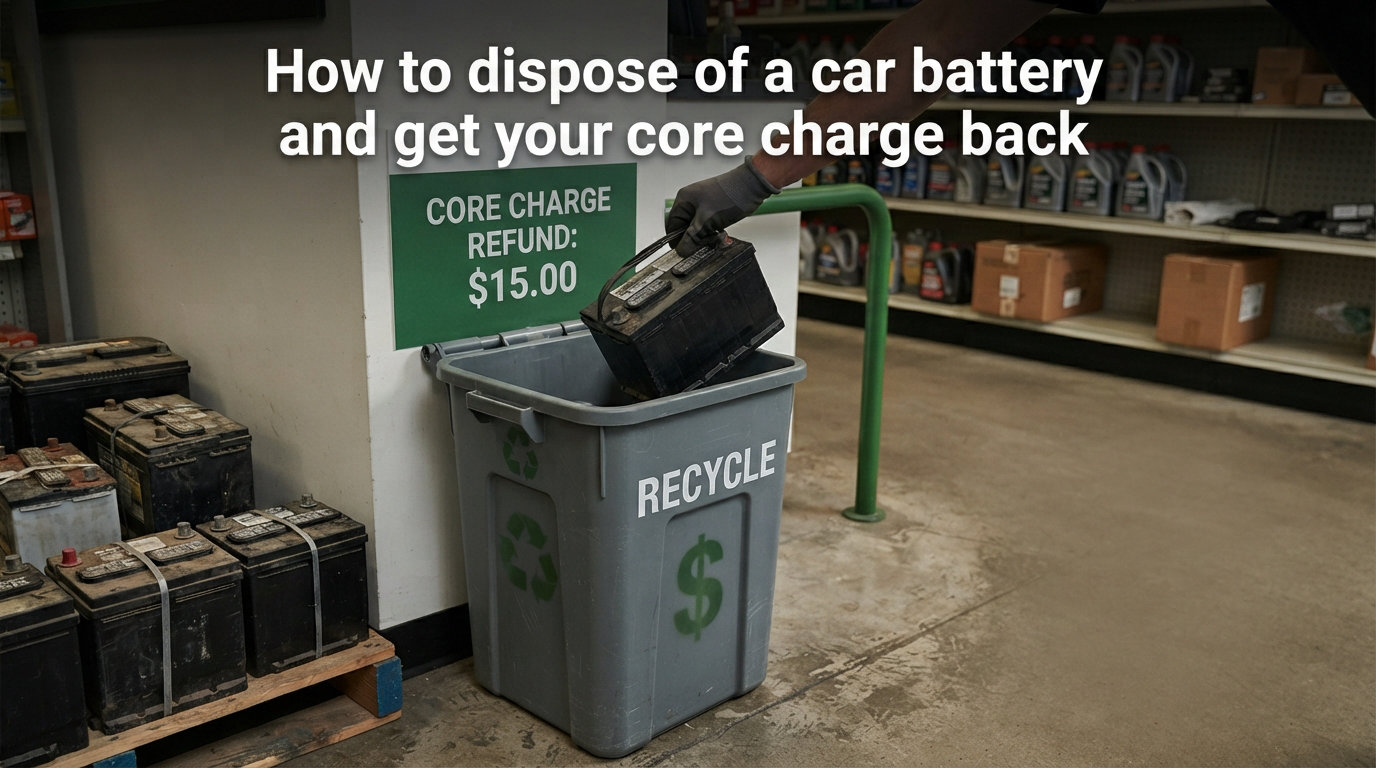
If you just swapped out your car battery, you might be staring at an old, heavy lead-acid brick wondering what to do with it. The good news is that learning how to dispose of a car battery and get your core charge back can put real money back in your pocket. Most auto parts stores will hand you a refund, gift card, or store credit when you return that dead battery to them.
A core charge is basically a deposit you already paid when you bought the new battery. That deposit is sitting there waiting for you to claim it, and the process is simpler than you might think. You just need to know where to go, what to bring, and how to handle the old battery safely.
In this guide, I will walk you through every step from removing the battery safely to walking out of the store with your refund. I have pulled together real-world experiences from car owners on forums like Reddit and r/MechanicAdvice, along with current store policies from major retailers. By the end, you will know exactly how to dispose of a car battery and get your core charge back without any guesswork.
Table of Contents
What Is a Battery Core Charge?
A core charge is a refundable deposit (typically $10 to $25) that retailers add to the price when you buy a new car battery. This deposit exists to encourage you to return your old battery for proper recycling instead of tossing it in the trash. In most U.S. states, this deposit is required by law.
The concept is simple. You pay the core charge upfront when purchasing the new battery, and you get that money back when you return the old one. Think of it like a bottle deposit, but for something far more dangerous to the environment. The old battery itself is called the “core,” and it still has value because the lead, plastic, and acid inside can all be reclaimed and reused.
Core charges are not unique to car batteries. The same deposit system applies to alternators, starters, brake calipers, and other rebuildable auto parts. Any component that can be remanufactured or recycled may carry a core fee. But car batteries are by far the most common core charge people encounter because almost every driver replaces at least one in their lifetime.
The exact amount varies by retailer and battery type. You will usually see the core charge listed as a separate line item on your receipt, so it is easy to identify exactly how much you are owed when you bring the old battery back.
Why Core Charges Exist: The Environmental Reason
Car batteries are made of lead, plastic, and sulfuric acid, which are all materials that cause serious environmental damage if they end up in a landfill. Lead is a toxic heavy metal that contaminates soil and groundwater. Sulfuric acid can burn skin on contact and leach into water supplies. The plastic casing takes centuries to break down.
Core charges exist to prevent that from happening. By requiring a financial deposit, the system creates a strong incentive for people to return old batteries rather than dump them. And it works. According to the EPA and the Battery Council International, over 98% of all lead-acid batteries in the United States are recycled, making them the most recycled consumer product in the country.
That recycling rate is remarkable when you consider that the same lead from a battery you return today could end up in a new battery months later. The lead is melted down and reformed, the plastic is shredded and remolded, and even the acid is neutralized and converted into sodium sulfate for use in manufacturing. Almost nothing goes to waste.
Most states have laws requiring retailers to charge a core deposit on car battery sales. Some states mandate specific minimum amounts, while others leave it to the retailer. A handful of states also make it illegal to dispose of car batteries in regular trash, with fines for violations. The core charge system is the practical mechanism that keeps this whole recycling loop functioning.
How to Safely Remove a Car Battery
Before you can return your old battery for a core charge refund, you need to get it out of your vehicle. This is a straightforward job, but safety comes first since you are handling a device full of acid and capable of delivering a serious electrical shock.
Step 1: Park safely and gather your gear. Park on a flat surface, turn off the engine, remove the key, and make sure all lights and accessories are off. Put on safety glasses and work gloves. You will need a wrench or socket set (usually 10mm) and a battery terminal puller if the cables are stuck.
Step 2: Locate and identify the terminals. Open the hood and find the battery. Identify the positive terminal (marked with a plus sign and usually covered by a red cap) and the negative terminal (marked with a minus sign, usually black).
Step 3: Disconnect the negative terminal first. This is critical. Always remove the negative cable before the positive one. If you remove the positive first and your wrench touches any metal surface, you will create a short circuit that can cause sparks, burns, or even an explosion from battery gases. Loosen the nut on the negative terminal and slide the cable off.
Step 4: Disconnect the positive terminal. Once the negative is safely off and moved aside, loosen and remove the positive cable the same way. Tuck both cables away from the battery so they cannot accidentally spring back and touch the terminals.
Step 5: Remove the hold-down bracket. Most batteries are secured by a metal or plastic bracket at the base. Remove the bolt or nut holding this bracket in place and set the bracket aside.
Step 6: Lift the battery out carefully. Car batteries weigh 30 to 50 pounds, so lift with your legs. Grab it firmly by the sides, keep it level to avoid spilling acid, and set it down on a stable surface. Never tilt the battery sharply or drop it.
How to Prepare Your Old Battery for Return?
Once the battery is out, you should get it ready for transport to the store. A little preparation goes a long way toward a smooth return process.
Start by inspecting the battery for cracks, bulges, or heavy leakage. If the case is cracked and leaking acid, wrap it in heavy plastic and place it in a plastic tub to contain any spills. Most stores will still accept damaged batteries for recycling, but you want to avoid getting acid in your car during transport.
Next, clean the battery. Baking soda and water is your best friend here. Mix a few tablespoons of baking soda with water and apply it to any corrosion or acid residue on the terminals and case. You will see it fizz as the baking soda neutralizes the acid. Wipe it clean with a rag and let it dry. This step keeps your hands and your car interior safe during the drive.
For transport, place the cleaned battery inside a sturdy cardboard box lined with a heavy trash bag. This is a method recommended by experienced DIYers on car forums. The box gives you something to grip, and the trash bag catches any residual moisture. Keep the battery upright in your trunk or truck bed, and secure it so it cannot tip over.
Bring your original purchase receipt if you have it. This is your proof of the core charge amount, and it makes the refund process instant. If you lost the receipt, do not worry, I cover receipt-less strategies later in this guide.
How to Dispose of a Car Battery and Get Your Core Charge Back
Now for the main event. Here is the step-by-step process for returning your battery and collecting your core charge refund.
Step 1: Choose your return location. The easiest option is to return the battery to the same store where you bought the replacement. They have your purchase on file and can process the refund immediately. But many stores will accept any old battery regardless of where it was purchased.
Step 2: Bring the battery inside. Carry the battery (in its box or bag) to the counter and tell the employee you want to return it for a core charge refund. They will take the battery and check your receipt or look up the transaction.
Step 3: Receive your refund. If you bought the replacement at the same store and have your receipt, you will typically get the core charge back in the same form you paid, whether that is cash or a return to your card. If you are returning a battery without a purchase, most stores give you a gift card instead.
Step 4: Keep your documentation. Some stores provide a receipt or confirmation for the core return. Hold onto it until you confirm the refund posted, especially if it is going back to a debit or credit card.
The whole process usually takes under five minutes. The employee inspects the battery to make sure it is not completely shattered, processes the return, and hands you your money or gift card. That is how to dispose of a car battery and get your core charge back in the simplest terms.
One important note: the battery you return does not need to be the exact same one you bought. It just needs to be a comparable car battery of roughly the same size and type. Stores care that you are returning a valid lead-acid battery core, not that it matches the serial number on your receipt. This is something many people do not realize, and it comes up constantly on car advice forums.
Store-by-Store Core Charge Refund Policies
Not all stores handle core returns the same way. Here is what you can expect from the major retailers, based on current policies and real customer experiences shared on forums.
AutoZone: AutoZone is one of the most popular options for battery core returns. If you bought your replacement battery there, you get your full core charge back with a receipt. The typical core charge at AutoZone runs around $12. Even better, AutoZone often gives a $10 gift card for old batteries even if you did not buy anything from them. This makes it a great option if you just have a dead battery lying around.
O’Reilly Auto Parts: O’Reilly operates similarly to AutoZone. They charge a core deposit on new battery purchases (usually $10 to $15) and refund it when you bring the old one back with a receipt. Forum users report that O’Reilly also pays for old batteries without a purchase, typically in the $10 range.
Advance Auto Parts: Advance accepts core returns at all locations and refunds the core charge to your original payment method. Their core charges are comparable to competitors, generally $10 to $18 depending on battery type. They also offer a Speed Perks loyalty program that sometimes stacks with battery promotions.
Walmart: Walmart charges a core fee on batteries sold in their automotive section. To get the refund, you must return the old battery to the automotive counter at Walmart, not the regular customer service desk. The core charge at Walmart is typically $5 to $12. Some users on Reddit report inconsistent experiences with Walmart core refunds, especially at locations where the automotive counter is understaffed, so call ahead.
Costco: Costco sells car batteries with a core charge, and you can return your old battery to the membership counter for a refund. Costco’s core charges run around $15 to $22. You will need your membership card and ideally the original receipt. Costco is known for generous return policies, but some members report confusion at the counter about battery core processing.
Menards: Menards charges core fees on battery purchases but is stricter than auto parts chains. Multiple forum users report that Menards requires either the original receipt or a new purchase to process a core refund. They are less likely to give cash for a random old battery compared to AutoZone or O’Reilly.
Scrap yards and metal recyclers: If no auto parts store is convenient, local scrap yards will buy old car batteries by weight. Lead is a valuable scrap metal, and you can expect anywhere from $7 to $15 per battery depending on current lead prices. Call ahead to check rates and hours.
Getting a Core Charge Refund Without a Receipt
Lost your receipt? You still have options, though the process is not always as smooth. Here is what I found from digging through forum discussions and store policies.
At auto parts stores like AutoZone and O’Reilly, the employee can often look up your purchase using your phone number or the credit card you used. If they can find the transaction in their system, they can process the core refund without a physical receipt. This works best if you are a rewards member or used a phone number at checkout.
If the store cannot find your transaction and you have no receipt, they may offer store credit or a gift card for the battery instead of a full cash refund. The amount might be lower than the original core charge, typically $10 as a flat gift card rate for an old battery. It is not ideal, but $10 is better than nothing.
Walmart and Costco are stricter. Both retailers strongly prefer the original receipt for core refunds, and without it, you may be out of luck or limited to store-level discretion. Costco can look up purchases on your membership account, which effectively replaces the receipt, so bring your card.
Getting a Core Refund Without Buying a New Battery
This is one of the most asked questions online, and surprisingly few guides cover it clearly. The answer is yes, you can get money for an old battery without making any purchase at all.
AutoZone leads the pack here. Multiple Reddit users across r/MechanicAdvice and r/Cartalk confirm that AutoZone gives a $10 gift card for old car batteries with no purchase required. You walk in, hand over the battery, and walk out with a gift card. O’Reilly and Advance Auto Parts have similar programs at many locations, though the exact amount and format can vary by store.
This is fantastic if you cleaned out a garage and found a couple of old batteries from previous owners. Each one is worth roughly $10 if you are willing to make the trip. Some resourceful people even collect old batteries from neighbors and scrap them in batches.
If auto parts stores in your area do not pay without a purchase, head to a scrap metal yard. They pay by weight and current lead market value, which usually lands between $7 and $15 per battery. Some recycling centers also accept batteries and may offer small payments or recycling incentives depending on your state.
State Recycling Laws and Legal Requirements
Core charges are not just a store policy. In most U.S. states, they are mandated by law. The specifics vary, but the general framework is the same everywhere.
Over 30 states require retailers to charge a core deposit on car battery sales. Some of these states set a minimum deposit amount, while others let retailers determine the charge. States with strong battery recycling laws include California, Florida, Minnesota, Washington, and New York, among many others.
In several states, it is illegal to dispose of a car battery in your regular household trash or curbside recycling. Violators can face fines ranging from $50 to several hundred dollars. Retailers are also legally required to accept used batteries for recycling, even if you did not buy from them. This means you can walk into almost any auto parts store in the country and hand them a dead battery.
If you live in a state without a mandatory core charge law, retailers may still charge one voluntarily as part of their own recycling programs. In those cases, the refund policy is set by the store rather than state law, so always ask about the terms at the time of purchase.
Time Limits and Matching Requirements for Core Returns
Two questions come up constantly on car forums: how long do you have to return the old battery, and does it need to match the new one?
Time limits vary by retailer. Auto parts chains like AutoZone, O’Reilly, and Advance Auto Parts generally do not enforce a strict deadline for core returns. You can return the battery weeks or even months later and still get your refund. However, some big-box stores like Walmart and Menards may apply their general return policy timeframes, typically 30 to 90 days. Always ask about the time window when you buy the battery if you plan to return the core later.
As for matching, the returned battery does not need to be the exact same battery you purchased. It needs to be a comparable automotive battery, roughly the same BCI Group Size. If you bought a Group 24F battery, returning a Group 35 will sometimes work, but stores prefer an equivalent size. What matters most is that you are returning a legitimate lead-acid car battery core, not a smaller battery from a lawnmower or motorcycle (though some stores accept those too for a lower amount).
One edge case: if your old battery is physically broken open with exposed plates and leaking acid everywhere, some stores may refuse it or ask you to bag it. Very few batteries are “too damaged” for recycling, but extremely damaged units may need to go directly to a hazardous waste facility instead.
FAQs
How do I get my core refund on my car battery?
Take your old battery to the store where you bought the replacement, along with your receipt. The employee processes the return and refunds the core charge as cash, card credit, or store credit. The whole process takes under five minutes.
Does AutoZone pay you for battery cores?
Yes. AutoZone refunds your full core charge if you have a receipt, and they also give a $10 gift card for old batteries even if you did not buy anything from them. No purchase is required for the gift card.
How much money do you get for a car battery core?
Core charges typically range from $10 to $25 depending on the retailer and battery type. AutoZone and O’Reilly usually charge around $10 to $15, while Costco and some big-box stores may charge $15 to $22. Scrap yards pay $7 to $15 per battery based on lead weight.
Is battery core charge refundable?
Yes, the core charge is fully refundable. It is a deposit, not a fee. When you return your old car battery to the retailer, they refund the core charge in full. Over 98% of lead-acid batteries are recycled thanks to this deposit system.
Does Walmart give money back for battery cores?
Yes, Walmart refunds core charges when you return the old battery to the automotive counter with your receipt. The core charge at Walmart is typically $5 to $12. Call ahead to confirm the automotive counter is staffed.
Can I return any car battery for a core charge?
In most cases, yes. The battery does not need to be the exact one you purchased. It just needs to be a comparable automotive lead-acid battery of roughly the same size. Stores care about receiving a valid core, not matching serial numbers.
Conclusion
Now you know exactly how to dispose of a car battery and get your core charge back. The process comes down to three steps: remove the old battery safely, clean it for transport, and return it to a retailer for your refund. Whether you head to AutoZone for a $10 gift card or back to the store where you bought your replacement for a full core charge refund, you are getting paid to do the right thing for the environment.
Do not let that old battery sit in your garage collecting dust. That is money on the shelf, and a toxic hazard waiting to happen. Grab your gloves, box up the battery, and go collect what is yours.